Terrarium Substrate Cooler
Concept
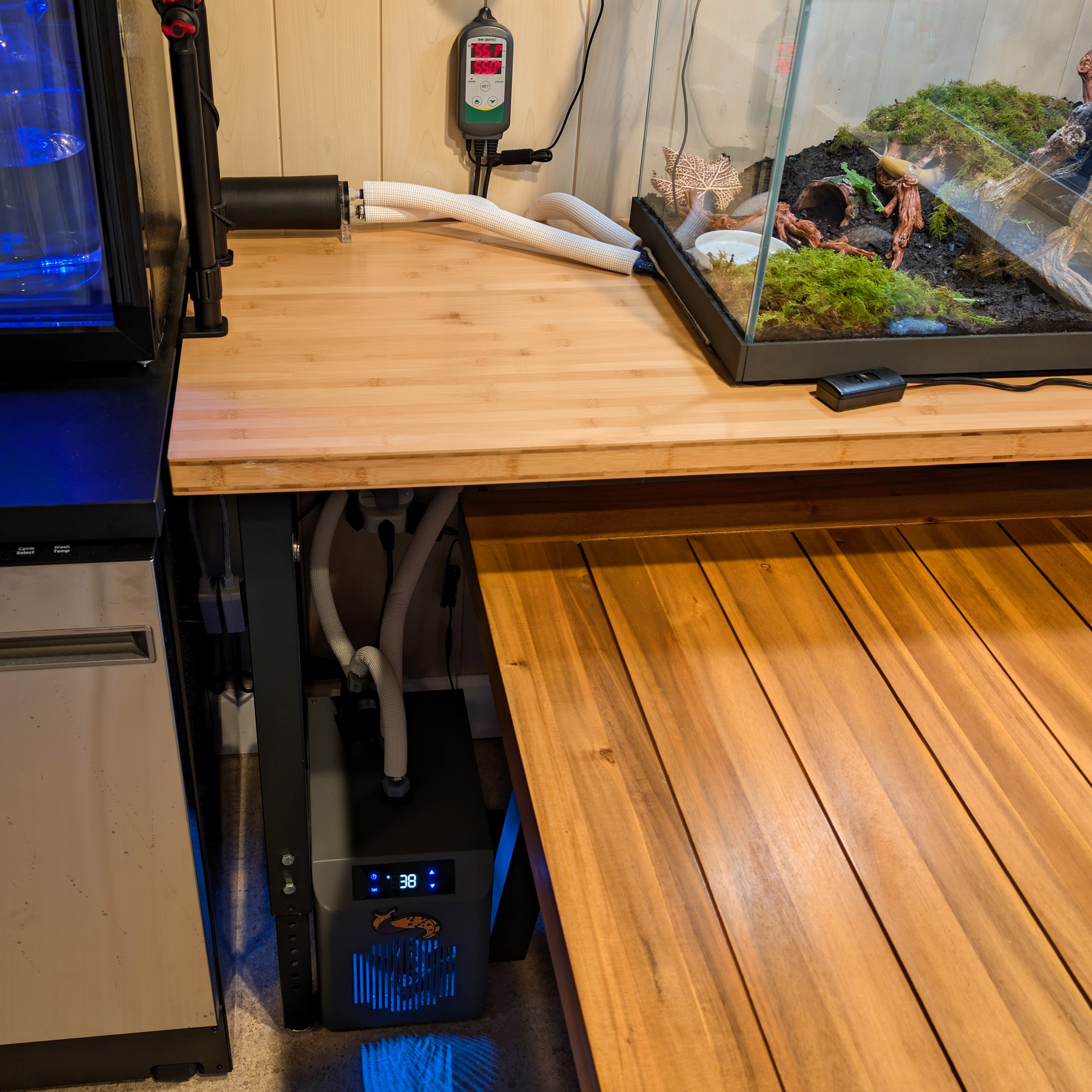
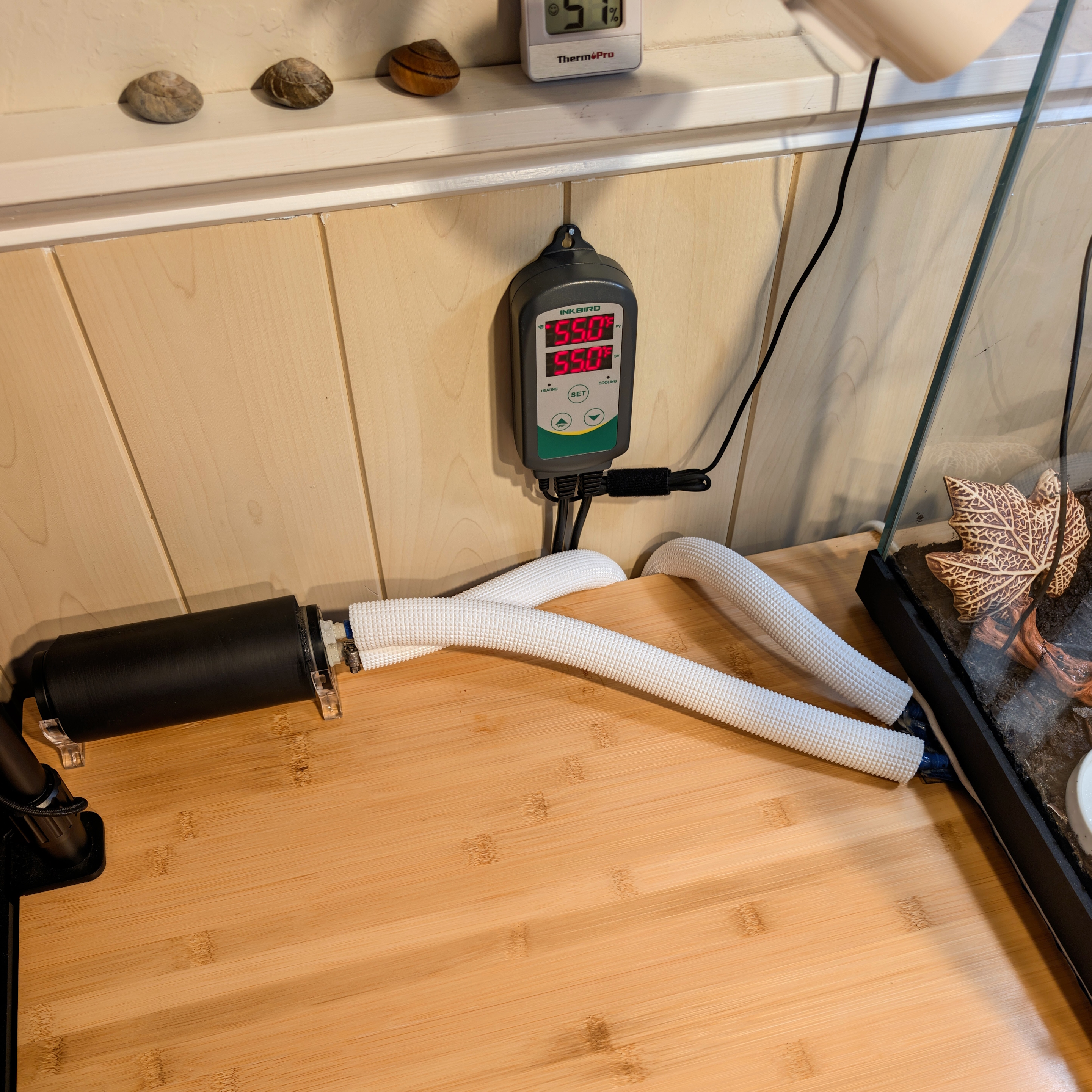
The use of an aquarium chiller to cool water pumped through a cold-therapy pad, which can be placed beneath an enclosure. This enables a wide range of cooling targets without directly impacting humidity, and creates a vertical thermal gradient similar to those found in nature — allowing residents to pick and choose their ideal temperature.
I developed this solution for Banana Slugs, which prefer temperatures of ~55°F (13°C). However it's also useful for Velvet Worms, and generally beating the summer heat.
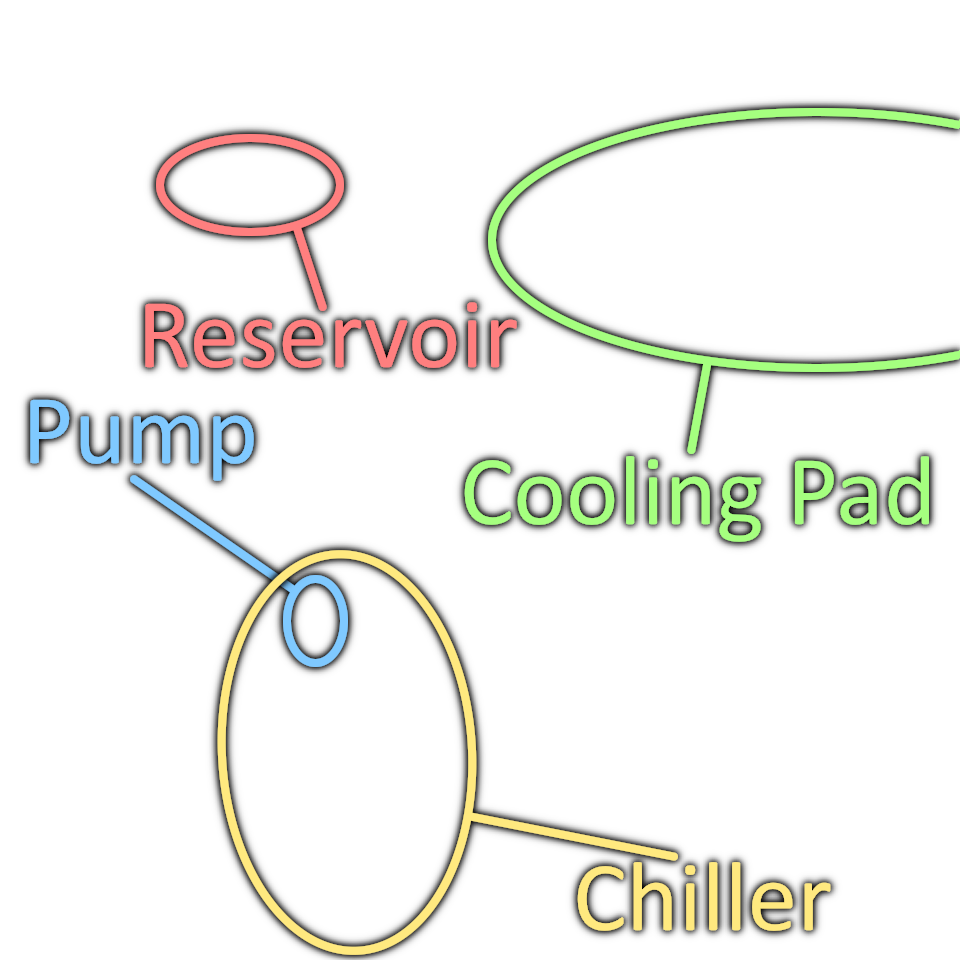
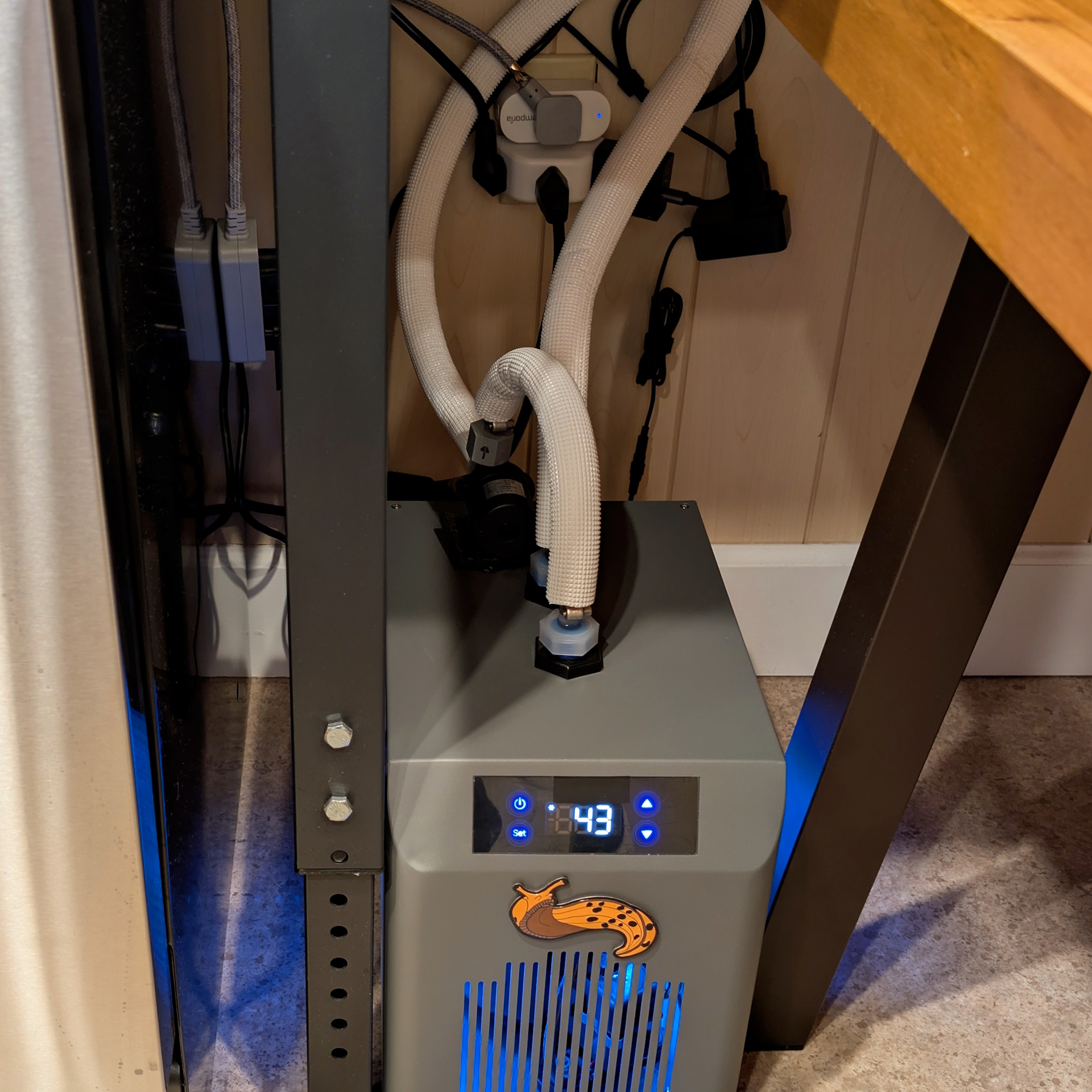
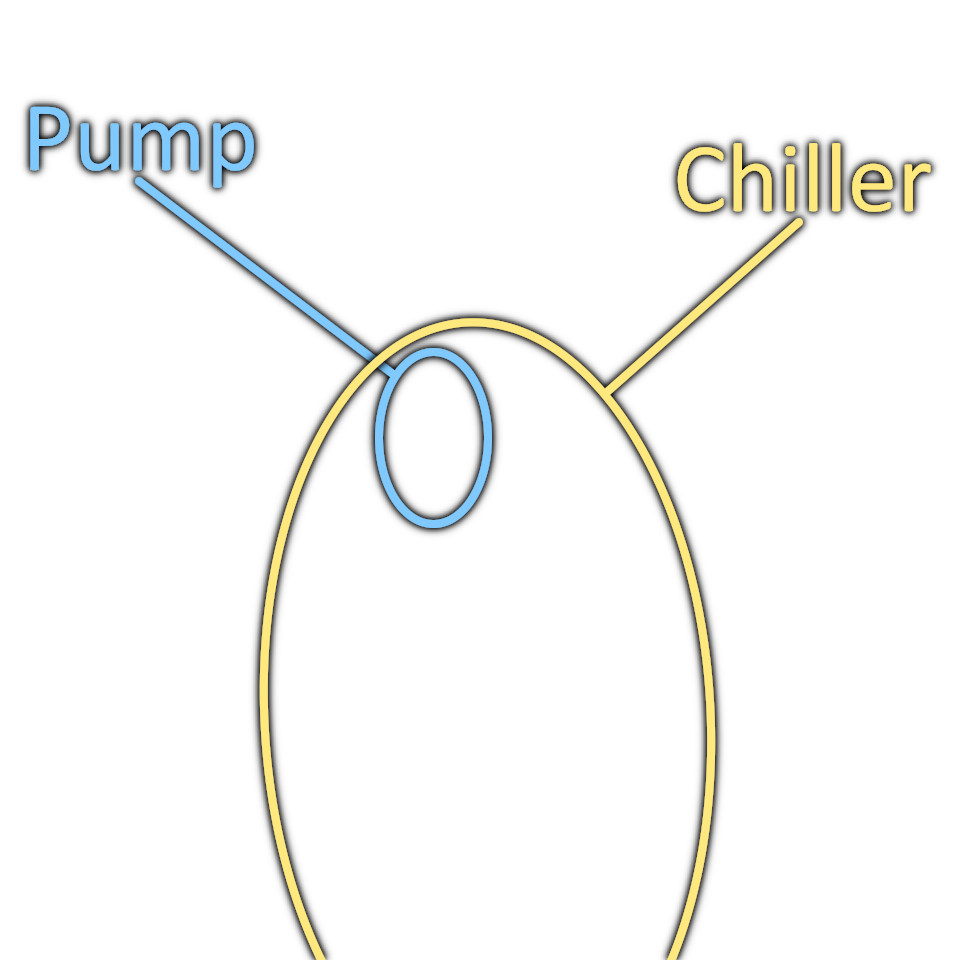
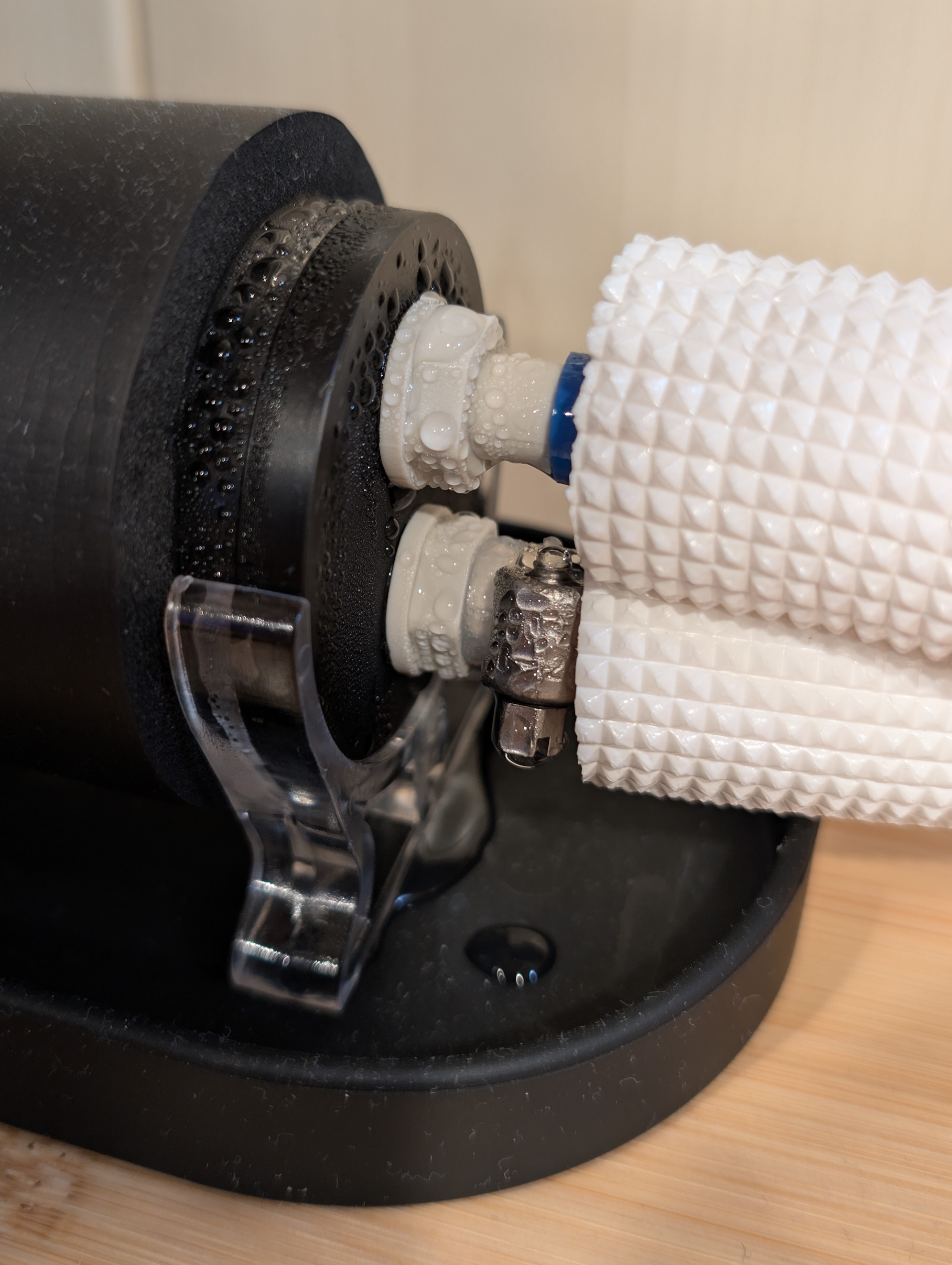
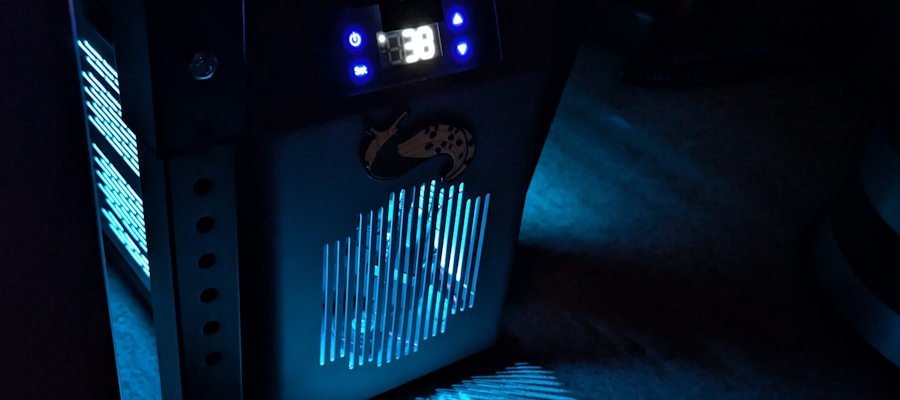
Tap pictures for annotation.
Prerequisites
- The flat base of your enclosure must sit flush against the surface it's set upon — there cannot be any trim pieces on the bottom edges keeping it elevated.
- The enclosure can only sit upon a solid surface — meaning no holes, slats, or gaps.
- Ensure adequate space for the reservoir at or above the enclosure's platform, and for the chiller to be lower than the reservoir.
- Reservoir: 12"W x 3"D x 4"H (30 x 8 x 10cm)
- Chiller: 12"W x 16"D x 18"H (30 x 40 x 46cm)
Parts List
Prices Last Updated: March 19th, 2026
Minimum Parts
| Aquarium Chiller |
168.96 |
| Water Pump |
18.99 |
Pump failed after ~1yr of operation — consider keeping a spare. |
| 12v Power Supply |
6.99 |
To power pump. |
| Cooling Pad |
57.99 |
Subtract 4" (10cm) from each of your enclosure's footprint dimensions to determine the largest pad that may be used. This ensures enough space for the risers to support the enclosure's weight. |
| Water Reservoir |
17.59 |
Collects air trapped in cooling loop. |
| Reservoir Cap |
6.59 |
To seal reservoir's fill-port.
|
| Reservoir Insulation |
13.08 |
To improve thermal performance and limit condensation. |
| Wax Lubricant |
14.97 |
Enables installation of reservoir's insulation.
|
| G1/4 to 5/16 Barb |
7.19 |
Reservoir fittings. |
| G1/2 to 8mm Barb |
9.49 |
Replaces pump's fittings for use with 5/16 tubing. |
| G3/4 to 5/16 Barb |
8.29 |
Replaces chiller's fittings for use with 5/16 tubing. |
| 1/4 to 5/16 Barb |
3.49 |
To adapt and extend cooling pad tubing. |
| 5/16 Tubing |
5.99 |
To interconnect loop's elements. |
| Tubing Insulation |
13.42 |
To improve thermal performance and limit condensation. |
| Hose Clamps |
5.58 |
To secure tubing to barb fittings. |
| Risers |
13.75 |
To create gap for cooling pad beneath enclosure. |
| Thermal Probe |
5.45 |
To monitor substrate temperature. |
| 1G Distilled Water |
2.00 |
Coolant. |
|
Total |
|
|
Optional Upgrades
| Silicone Mat |
9.99 |
To protect surface beneath cooling pad from condensation if coolant drops below dew point. |
| Silicone Tray |
14.99 |
To protect surface beneath reservoir from condensation if coolant drops below dew point. |
| Enclosure Insulation |
13.99 |
To improve thermal performance. Install to any unobstructed surfaces on outside of the enclosure, at and below substrate height. |
| Substrate Heatsink |
13.99 |
To greatly improve thermal performance by aiding vertical conductivity within substrate. Select the largest "width" that the intended substrate depth can hide. Wash to remove machine oils, and place flat face atop the glass directly above cooling pad — before adding any substrate. Multiple are recommended for most footprints — spaced in parallel with their vertical faces ~4" (10cm) apart. Affix after placement with silicone on only the lengthwise edges of each segment, so as to not insulate the glass/metal interface with either silicone or trapped air. |
| Damper Pads |
12.14 |
Affixing to the base of pump reduces vibration noise. |
| 2L Specialized Coolant |
49.99 |
Contains biocide, limits bubbles, and lubricates pump for a longer life. |
| Substrate Thermostat |
18.99 |
Replaces the substrate probe, enabling thermal stability in highly variable ambients by controlling power to the pump and chiller. Set coolant thermostat to 34°F (1°C). Substrate varied by 3°F (1.5°C) with a 1°F (0.5°C) substrate thermostat differential. |
| Time-Delay Outlet |
31.99 |
Protects chiller from damage if utility power is briefly lost. Install between outlet and chiller, or between outlet and substrate thermostat if one's used. |
Assembly
It's only about half as hard as it looks.
Required Tools
| Slot Screwdriver |
To fasten hose clamps and reservoir cap. |
| 14mm Wrench or Pliers |
To fasten G1/4 fittings. |
| Measuring Tape |
To measure for cuts. |
| Scissors |
To cut tubing and insulation. |
| Small Funnel |
To fill reservoir with coolant. |
| Paper Towels |
To clean excess wax and soak up any leaked coolant. |
Instructions
Prep Chiller
- Chillers must be kept upright for at least 24 hours before any operation, which ensures that their compressor's oil has settled to a safe level. Failure to allow this time often results in compressor damage.
- Set aside the water pump that's included with the chiller, as it's incompatible with this use case.
- Locate two G3/4 to 5/16 barb fittings, and place one of the chiller's included o-rings within each.
- Fasten these two prepped fittings to the top of the chiller.
Prep Cooling Pad
- With scrissors, cut the fitting off the end of the pad's tubing and discard the included insulation.
- Cut the pad's remaining tubing to 1" (25mm) lengths and discard the removed lengths.
- Press the small end of a 1/4 to 5/16 barb fitting into each of the pad's tubes.
Prep Reservoir
- Ensure that the reservoir's black end pieces are fully-threaded to the acrylic glass, as they may have loosened during shipping.
- Identify the end with two holes and affix a G1/4 to 5/16 barb fitting to each. Threads are tight so double-check that the gaskets squash upon fastening.
- Affix the reservoir cap to the end with only one hole.
Prep Pump
- Set aside pump's included fittings, as they aren't compatible with this use case.
- Affix a G1/2 to 8mm barb fitting and their included o-ring to each of the pump's ports.
Stage Components
- Place the chiller, cooling pad (plastic face upward), reservoir (oriented horizontally), and pump in your planned locations. The reservoir in particular must be at the loop's highest point, as its role is to collect trapped air while the coolant cycles.
- Measure for four tubing lengths — one between pad and reservoir, pad and chiller, chiller and pump, as well as the reservoir and pump. Lengths should have some slack.
Prep Tubing
- Cut tubing in accordance with the previous measurements.
- Sleeve the tubing insulation such that all but 1" (25mm) at each end of the tubes are fully covered. Fitment is very tight, so avoid sleeving more than 18" (45cm) of insulation at a time.
Install Tubing
- Use the now-insulated tubing to connect the pump's side fitting to one on the chiller, and the chiller's remaining fitting to one on the pad. Connect the pad's remaining fitting to the reservoir fitting featuring an internal tube (visible through the acrylic), and connect the reservoir's second fitting to the pump's remaining fitting.
- Ensure that the reservoir can rotate such that the port connected to the pad is oriented above the one leading to the pump.
- Affix hose clamps to the tubing over their fitting's barbs.
- Take a break — this is about to get spicier.
Add Coolant
- Reassess fittings to confirm that they're sufficiently secure.
- Plug the pump's power supply into its planned outlet, and be ready to connect it to the pump.
- Remove reservoir cap and orient the reservoir such that its open port faces up and the tubes are downward, again ensuring that the reservoir is the loop's highest point.
- Loosely insert a funnel into the open port and add coolant until the reservoir is ~80% full.
- While maintaining reservoir orientation, connect the pump to its power supply.
- Coolant should drain from the reservoir and there will be strange noises as the pump struggles with air pockets. Keep adding coolant to the reservoir and maintain a coolant level of at least 80% (it's okay if it drops below this level for short periods).
- Once the coolant's flow seems steady and the reservoir maintains at least an 80% coolant level on its own, ensure that this remains the case for at least 2 consecutive minutes.
- Reaffix the reservoir's cap and set it back in its planned location.
- Disconnect the pump from power.
- The loop is now under pressure, so over the next 5 minutes inspect fittings for leaks and tighten anything suspect.
Add Reservoir Insulation
- Cut the reservoir insulation to a length of 5.5" (14cm).
- Coat the insulation's inner surface as well as the reservoir's circumference with wax lubricant, else the fitment will be too tight.
- Sleeve insulation over the reservoir until the coolant is no longer visible.
- Clean up excess lubricant with a paper towel.
- Find the reservoir's clear plastic feet and affix them to the black end caps.
- Set the reservoir back down, and rotate it such that the port leading to the pad is oriented above the port leading to the pump.
Position Cooling Pad
- Move cooling pad aside and set the enclosure in its planned location.
- Place a rubber riser beneath each of the enclosure's four corners.
- Lift one side of the enclosure and slide only the cooling mat (not the tubes) beneath it.
- Set the enclosure back down and ensure that each of the risers is taking some of the enclosure's weight. The pad should be compressed against the glass but not taking all of the enclosure's weight.
- Power the pump back up.
Populate Enclosure
- Add substrate, keeping in mind that its depth is a factor in temperature deltas. A height gradient will create a thermal gradient, which may or may not be desireable.
- Install thermometer with its probe above the cooling pad on the substrate's surface.
Configure Chiller
- Power on the chiller and set its thermostat differential to 4°F (2°C).
- Set a coolant temperature based on the performance deltas in the following section.
- Take a break for ~6 hours to allow the enclosure's thermals to settle.
Tune System
- Reassess fittings for leaks and tighten anything suspect. Some condensation is normal if coolant drops below the dew point.
- Begin adjusting the coolant's temperature to reach the desired substrate temperature, and allow ~2 hours before reassessing these adjustments.
Observation Conditions
| Ambient |
72°F (22°C) |
| Substrate Target |
55°F (13°C) |
| Substrate Material |
1" (25mm) Topsoil |
| Enclosure Material |
5/16" (8mm) Glass |
| Enclosure Footprint |
24 x 18" (60 x 45cm) |
Water to Substrate Deltas
| Wet Soil |
7°F (4°C) |
| Dry Soil |
15°F (8°C) |
A delta is the difference between two values, which in this case compares the water temperature with that of the substrate's surface. The smaller the delta, the more efficient the cooling.
Power Draw
| Idle |
7W |
| 48°F (9°C) Water |
145W (30% Duty) |
| 40°F (3°C) Water |
145W (90% Duty) |